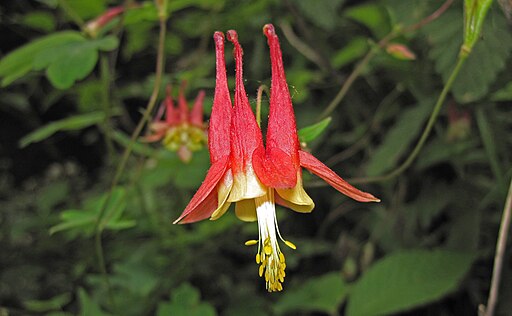
Wild Columbine (Aquilegia canadensis)
Wild Columbine (Aquilegia canadensis)
Couldn't load pickup availability
The Hummingbird's Spring Treasure
Wild Columbine (Aquilegia canadensis) is one of the most elegant and distinctive native wildflowers, producing nodding red and yellow flowers with distinctive backward-pointing spurs from April through June. This graceful perennial reaches heights of 1-3 feet and creates delicate, airy displays with its unique flower architecture and attractive blue-green foliage. Wild Columbine demonstrates remarkable adaptations for hummingbird pollination, thrives in partial shade and rocky sites, and provides critical early-season nectar for ruby-throated hummingbirds returning from migration.
Fibrous Roots & Shade Adaptation
Wild Columbine develops a fibrous root system that spreads through the upper 1-2 feet of soil, forming partnerships with arbuscular mycorrhizal fungi that enhance nutrient uptake in the rocky, well-drained soils it prefers. Unlike many prairie plants that require full sun, Wild Columbine thrives in partial shade to full sun, making it particularly valuable for woodland edges, rocky slopes, and savanna restorations. The plant naturally grows on cliff faces, rocky outcrops, and gravelly sites where its roots can penetrate crevices and access moisture while enjoying excellent drainage. This adaptation to challenging sites makes it useful for rock gardens, slopes, and areas where other plants struggle. The roots are relatively shallow compared to deep-rooted prairie plants, allowing Wild Columbine to coexist with trees and shrubs.
Specialized Hummingbird Pollination
Wild Columbine's distinctive flower structure is a textbook example of adaptation for hummingbird pollination. The five backward-pointing spurs contain nectar at their tips, positioned perfectly for ruby-throated hummingbirds to access with their long tongues while hovering. The red and yellow color combination is highly attractive to hummingbirds (who see red very well) while being less visible to bees (who don't see red as effectively). The nodding orientation positions the flower perfectly for a hovering hummingbird to feed while preventing rain from diluting the nectar. Wild Columbine blooms during the critical period when ruby-throated hummingbirds return from Central American migration (April-May), providing essential early-season fuel when few other nectar sources are available. The flowers also attract long-tongued bumblebees and sphinx moths who can access the nectar in the spurs.
Delicate Foliage & Self-Seeding Habit
The blue-green compound leaves are divided into rounded leaflets that create an attractive, delicate texture throughout the growing season. The foliage resembles that of meadow rue and provides ornamental value even when the plant isn't flowering. Wild Columbine is a relatively short-lived perennial (3-5 years typically), but it self-sows readily in favorable conditions, creating naturalized colonies that persist indefinitely. The seed capsules split open when mature, scattering seeds that germinate the following spring. This self-seeding habit allows Wild Columbine to move around the garden, appearing in rock crevices and unexpected spots where conditions suit it.
Unique Facts:
- The genus name Aquilegia comes from the Latin word for "eagle," referring to the spur shape that resembles an eagle's talons
- The common name "columbine" derives from the Latin word for "dove," as the inverted flowers were thought to resemble a circle of doves
- Can bloom as early as April in southern regions, making it one of the first hummingbird flowers of the season
- More shade-tolerant than most prairie plants, thriving in dappled woodland light or north-facing slopes
- The seeds are eaten by various songbirds, and the foliage provides cover for small wildlife
- Indigenous peoples used the plant medicinally and the seeds as a love charm, though the plant contains toxic compounds and should not be consumed
Wild Columbine brings essential hummingbird support, delicate spring beauty, and shade-garden adaptability to your prairie—providing critical early-season nectar for returning ruby-throated hummingbirds, thriving in rocky or partially shaded sites where other plants struggle, and creating elegant displays that connect us to the specialized relationships between flowers and their pollinators.
Share