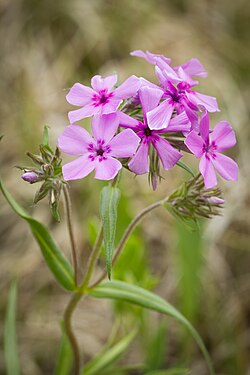
Prairie Phlox (Phlox pilosa)
Prairie Phlox (Phlox pilosa)
Couldn't load pickup availability
The Spring Prairie's Fragrant Pollinator Bridge
Prairie Phlox (Phlox pilosa), also known as Downy Phlox, is one of Wisconsin's most enchanting native wildflowers—a low-growing, sweetly fragrant perennial that blooms in May and June, filling the critical gap between spring ephemerals and the summer prairie bloom. The species name pilosa means "hairy" in Latin, a nod to the soft, downy stems and leaves that help the plant retain moisture and deter casual herbivores. Found naturally in dry to mesic prairies, open woodlands, and savanna edges, Prairie Phlox is a specialist's plant—supporting a tight web of co-evolved pollinators and serving as a host plant for rare moths found nowhere else.
Specialist Pollinators & the Bloom Gap
Prairie Phlox blooms from mid-May through June, a window when many early-season pollinators are actively foraging but summer wildflowers have yet to open. The tubular, five-petaled flowers are perfectly shaped for long-tongued pollinators—particularly Eastern Tiger Swallowtails (Papilio glaucus), Spicebush Swallowtails (Papilio troilus), and hummingbird clearwing moths (Hemaris thysbe), whose long proboscises can reach the nectar hidden deep in the floral tube. Native bumblebees and long-tongued mining bees also visit regularly. This early-season nectar source is critical infrastructure for pollinators building colony strength before summer.
Host Plant for the Phlox Moth
Prairie Phlox is the primary host plant for the Phlox Moth (Schinia indiana), a specialist moth whose caterpillars feed exclusively on Phlox species. This moth is considered a species of conservation concern across much of its range, and its survival is directly tied to the persistence of native phlox in prairie landscapes. By planting Prairie Phlox, you are providing irreplaceable habitat for this specialist—a relationship that has co-evolved over thousands of years and cannot be replicated by ornamental phlox cultivars. The plant also supports several generalist moth species whose larvae feed on the foliage, adding another layer of food web complexity.
Mycorrhizal Partnerships & Prairie Soil Health
Prairie Phlox forms associations with arbuscular mycorrhizal fungi that extend its root reach into the surrounding soil matrix, helping it access phosphorus and water in the dry, well-drained soils it prefers. The plant's fibrous root system, while not as deep as some prairie grasses, contributes to soil organic matter as roots cycle seasonally. Its preference for dry to mesic conditions makes it an excellent companion for Little Bluestem, Yellow Coneflower, and other dry-prairie species, where it fills the low-growing niche in a diverse, multi-layered plant community.
Unique Facts:
- The name pilosa ("hairy") refers to the soft, downy texture of the stems and leaves—an adaptation that reduces water loss and deters some leaf-feeding insects
- Prairie Phlox is one of the few native wildflowers that produces significant fragrance, attracting pollinators from a distance and making it a sensory highlight in any prairie planting
- The Phlox Moth (Schinia indiana) is a specialist so tightly linked to this plant that it is rarely found where native phlox has been eliminated from the landscape
- Blooms in shades ranging from pale lavender to deep pink-purple, with natural variation across populations—each plant is genetically unique
- Extremely drought-tolerant once established, thriving in sandy or rocky soils where many other wildflowers struggle
- Indigenous peoples used Phlox species medicinally, including preparations for skin conditions and as an eyewash
Prairie Phlox is a fragrant, ecologically irreplaceable bridge between spring and summer—supporting specialist moths, long-tongued butterflies, and early-season bees while weaving itself into the mycorrhizal fabric of the dry prairie community.
Share