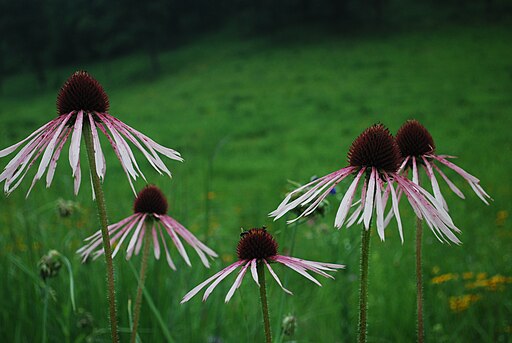
Pale Purple Coneflower (Echinacea pallida)
Pale Purple Coneflower (Echinacea pallida)
Couldn't load pickup availability
The Drought-Adapted Medicinal Specialist
Pale Purple Coneflower (Echinacea pallida) is the prairie's most drought-tolerant Echinacea species, thriving in the driest upland sites where other coneflowers struggle. This elegant wildflower is distinguished by its distinctive long, narrow, drooping petals that can reach 3-4 inches in length, creating a graceful, delicate appearance. Pale Purple Coneflower demonstrates remarkable adaptations for extreme conditions while producing some of the most potent medicinal compounds in the genus and supporting specialized pollinators.
Extreme Taproot & Drought Survival
Pale Purple Coneflower develops one of the deepest taproots of any prairie wildflower, reaching depths of 5-8 feet (sometimes up to 10 feet in sandy soils). This massive underground structure allows the plant to access water reserves far below the surface, making it virtually immune to drought once established. The taproot also stores enormous concentrations of medicinal compounds—research shows that E. pallida roots can contain higher levels of certain alkamides and caffeic acid derivatives than E. purpurea, making it particularly valued in herbal medicine. The deep roots form partnerships with arbuscular mycorrhizal fungi that help extract phosphorus and other nutrients from nutrient-poor upland soils. As the taproot grows and sheds outer layers, it adds organic matter deep into the soil profile, improving soil structure for surrounding plants.
Specialized Pollinator Relationships
The distinctive long, narrow petals aren't just beautiful—they serve as specialized landing platforms for long-tongued bees and butterflies. The drooping orientation creates a unique feeding angle that favors certain pollinator species, particularly long-horned bees (Melissodes species) and swallowtail butterflies who can navigate the unusual flower architecture. The prominent central cone produces abundant pollen over an extended bloom period (May through July, typically earlier than E. purpurea), providing critical early-season food when other nectar sources may be limited. Research has shown that some specialist bees preferentially visit E. pallida over other Echinacea species, suggesting co-evolutionary relationships that have developed over millennia.
Chemical Ecology & Medicinal Power
Pale Purple Coneflower produces a sophisticated array of bioactive compounds that provide defense against herbivores and pathogens while creating powerful medicinal properties. The roots contain high concentrations of alkamides, polysaccharides, and phenolic compounds that have demonstrated immune-modulating, anti-inflammatory, and antimicrobial effects in research studies. Indigenous peoples of the Great Plains used E. pallida extensively as medicine, often preferring it over other Echinacea species for treating infections, wounds, and snake bites. The plant's chemical defenses are so effective that it experiences relatively little herbivore damage even in areas with high deer pressure.
Unique Facts:
- The long, narrow petals (pallida means "pale") are typically lighter pink or nearly white compared to E. purpurea's deeper purple
- Can survive in extremely dry conditions with as little as 10-12 inches of annual rainfall once established
- The deep taproot makes it nearly impossible to transplant once mature—plants must be started from seed in their permanent location
- Blooms earlier than most other prairie coneflowers, providing critical early-season pollinator support
- The spiny seed heads persist through winter, feeding goldfinches and other seed-eating birds
- Historically more widely used medicinally by Plains tribes than E. purpurea due to its abundance in drier prairie regions
Pale Purple Coneflower brings drought-defying resilience, potent medicinal chemistry, and specialized pollinator support to your prairie—thriving in the toughest upland sites while creating a hub of biodiversity and connecting us to ancient healing traditions.
Share