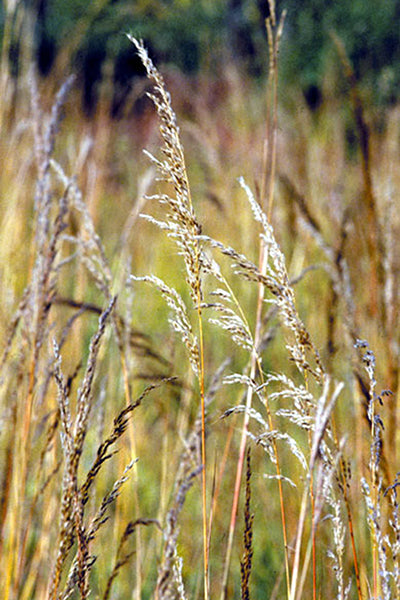
Indiangrass (Sorghastrum nutans)
Indiangrass (Sorghastrum nutans)
Couldn't load pickup availability
The Golden Prairie Sentinel
Indiangrass (Sorghastrum nutans) is one of the "Big Three" tallgrass prairie grasses, historically dominating millions of acres alongside Big Bluestem and Little Bluestem. This elegant warm-season grass reaches heights of 4-7 feet and is renowned for its spectacular golden-bronze plumes that shimmer in late summer and fall. Indiangrass is a crucial ecosystem component, providing unique habitat structure, supporting specialist wildlife, and demonstrating remarkable adaptations for nutrient efficiency.
Deep Roots & Mycorrhizal Mastery
Indiangrass develops a robust root system reaching 6-10 feet deep, with a distinctive architecture that combines deep taproots with extensive lateral fibrous roots. This dual strategy allows it to access deep water reserves while efficiently gathering nutrients from upper soil layers. The roots form particularly strong partnerships with arbuscular mycorrhizal fungi—research shows Indiangrass can have mycorrhizal colonization rates of 80-90%, among the highest of any prairie grass. These fungal networks dramatically increase phosphorus uptake (critical in prairie soils where phosphorus is often limiting) while the fungi receive up to 20% of the plant's photosynthetic sugars in return. This partnership is so effective that Indiangrass can thrive in nutrient-poor soils where other grasses struggle.
Allelopathy & Competitive Strategy
Indiangrass produces allelopathic compounds in its roots and decomposing leaf litter that can suppress the germination and growth of certain competing plants, particularly non-native cool-season grasses. This chemical defense helps maintain prairie diversity by preventing aggressive species from dominating. Interestingly, these compounds have minimal effect on most native prairie forbs and other warm-season grasses, which have co-evolved with Indiangrass for millennia. This selective suppression creates space for diverse wildflower communities to flourish between the grass clumps.
Wildlife Habitat & Seasonal Beauty
The distinctive golden plumes that appear in August and September are not just beautiful—they're highly efficient seed production structures. Each plume can produce hundreds of seeds that are rich in protein and oils, making them preferred food for numerous bird species including sparrows, juncos, and wild turkeys. The tall, sturdy stems provide important nesting sites for grassland birds and create winter shelter for small mammals and overwintering insects. In fall, the entire plant transforms into stunning shades of gold, orange, and bronze, maintaining its architectural presence and wildlife value throughout winter.
Unique Facts:
- The name "Indiangrass" likely refers to its golden color resembling the hue of tanned leather, though the exact origin is debated
- Can live for 20-30 years or more, creating stable, long-term habitat structure
- The distinctive yellow anthers that dangle from the seed heads create the golden shimmer that makes fall prairies glow
- As a C4 grass, it's extremely efficient in hot conditions and can continue photosynthesizing at temperatures that shut down most other plants
- Historically used by Indigenous peoples for thatching, weaving, and as a source of golden-yellow dye
- More shade-tolerant than most prairie grasses, making it valuable for savanna and woodland edge restoration
Indiangrass brings golden beauty and ecological sophistication to your prairie—forming powerful mycorrhizal partnerships, using chemical ecology to maintain diversity, and creating year-round wildlife habitat with its distinctive architectural presence.
Share