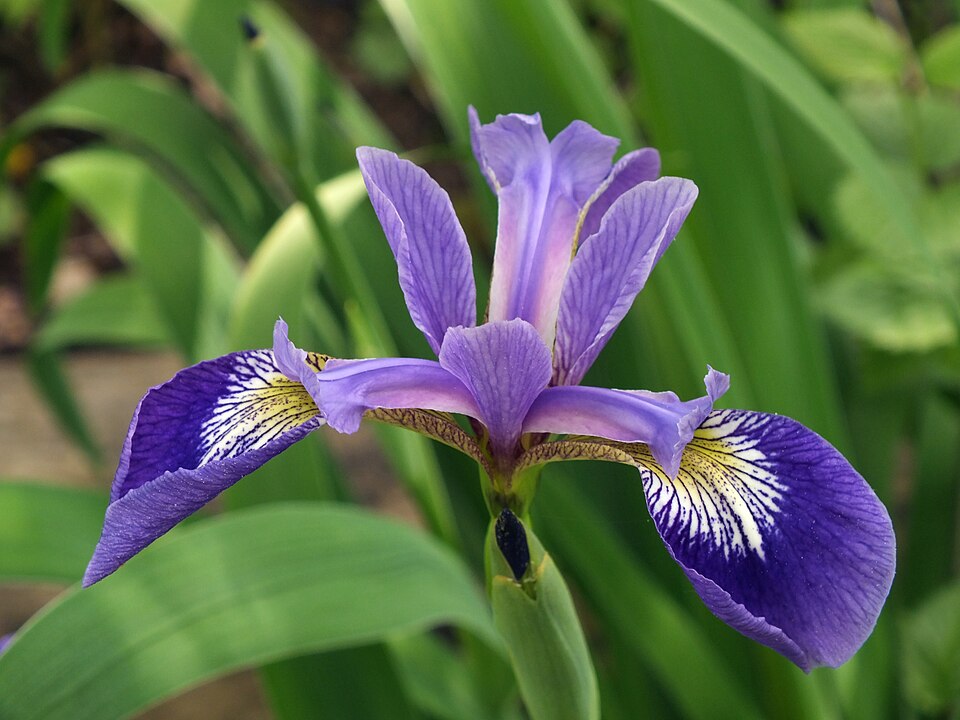
Blue Flag Iris (Iris versicolor)
Blue Flag Iris (Iris versicolor)
Couldn't load pickup availability
The Wetland's Iridescent Sentinel
Blue Flag Iris (Iris versicolor) is one of Wisconsin's most striking native wildflowers—a bold, violet-blue perennial that rises 2–3 feet tall from the edges of marshes, wet prairies, stream banks, and sedge meadows. Blooming in late May through June, its intricate flowers display the full complexity of co-evolved pollinator relationships, while its rhizomatous root system plays a critical role in stabilizing wetland soils and filtering water. Versicolor means "variously colored" in Latin, a fitting name for flowers that shift from deep violet to pale lavender with intricate yellow and white veining at the throat—a visual landing guide for pollinators that has been refined over millennia.
Pollinator Relationships & Floral Architecture
Blue Flag Iris has evolved a sophisticated pollination strategy centered on bumblebees, particularly Bombus species with the body size and strength to navigate the flower's architecture. The large, drooping "fall" petals serve as landing platforms, while the yellow and white nectar guides at the throat direct bees toward the reproductive structures hidden beneath the style branches. As a bee pushes inward to reach nectar, it contacts the anther and picks up pollen, then deposits it on the stigma of the next flower it visits—a precise, one-directional transfer that minimizes self-pollination. Hummingbirds and larger swallowtail butterflies also visit regularly, drawn by the abundant nectar produced during the 2–3 week bloom window.
Wetland Engineering & Water Filtration
Blue Flag Iris is a true wetland engineer. Its dense, interlocking rhizome network—spreading 1–2 feet laterally per year—binds streambank and shoreline soils with remarkable tenacity, reducing erosion during spring floods and heavy rains. The root system also plays an active role in phytoremediation: research has documented Iris versicolor's ability to absorb excess nitrogen and phosphorus from agricultural runoff, helping buffer water quality in degraded wetland margins. Planted along pond edges or rain garden borders, it functions as living infrastructure—beautiful above the waterline and quietly working below it. The plant forms associations with mycorrhizal fungi even in saturated soils, a relatively rare adaptation that extends its nutrient-gathering capacity in low-oxygen environments.
Wildlife Support Across Seasons
Beyond its bloom period, Blue Flag Iris continues to support wildlife through the growing season and into fall. The seed capsules split open in autumn to reveal buoyant, corky seeds that float downstream to colonize new sites—a dispersal strategy perfectly adapted to riparian corridors. Muskrats feed on the rhizomes, and the dense foliage provides nesting cover and shelter for red-winged blackbirds, marsh wrens, and a variety of wetland invertebrates. The upright seed stalks persist through winter, adding structural interest to the dormant wetland landscape.
Unique Facts:
- The name versicolor ("variously colored") refers to the intricate patterning of violet, white, and yellow on each flower—no two plants are identical in their color expression
- All parts of the plant are toxic if ingested, containing irisin and other compounds—a chemical defense that deters most mammalian herbivores while leaving invertebrate communities unaffected
- Blue Flag Iris is one of the few native perennials that thrives in standing water up to 4 inches deep, making it invaluable for rain gardens, bioswales, and restored wetland edges
- Indigenous peoples used the rhizomes medicinally with great care, and the tough leaf fibers were woven into cordage and mats—a testament to the plant's cultural significance across the Great Lakes region
- The seeds are specifically adapted for water dispersal, with a corky outer layer that keeps them buoyant for weeks, allowing colonization of new wetland sites downstream
- Research has shown Iris versicolor can remove up to 40% of excess phosphorus from constructed wetland systems, making it a valuable tool in water quality restoration
Blue Flag Iris is wetland infrastructure made visible—filtering water, anchoring shorelines, feeding pollinators, and sheltering wildlife while delivering one of the most spectacular floral displays in the native plant palette.
Share